The Storyteller by Mario Vargas Llosa
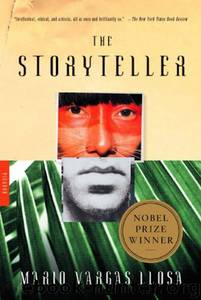
Author:Mario Vargas Llosa
Language: eng
Format: epub, mobi
Publisher: Farrar, Straus and Giroux
Published: 1988-12-31T16:00:00+00:00
For six months in 1981, I was responsible for a program on Peruvian television called the Tower of Babel. The owner of the channel, Genaro Delgado, had lured me into this venture by flashing before my eyes three shiny glass beads: the need to raise the standard of the channel’s programs, which had fallen to an absolute low of stupidity and vulgarity during the preceding twelve years of state ownership imposed by the military dictatorship; the excitement of experimenting with a means of communication which, in a country such as Peru, was the only one able to reach, simultaneously, a number of very different audiences; and a good salary.
It really was an extraordinary experience, though also the most tiring and most exasperating one that has ever come my way. “If you organize your time well and devote just half your day to the program, that’ll be enough,” Genaro had predicted. “And you’ll be able to go on with your writing in the afternoon.” But in this case, as in so many others, theory was one thing and practice another. The truth was that I devoted every single morning, afternoon, and evening of those months to the Tower of Babel, and most important, the many hours when I didn’t seem to be actually working but was nonetheless busy worrying about what had gone wrong on the previous program and trying to anticipate what would go worse still on the next one.
There were four of us who got out the Tower of Babel programs: Luis Llosa, the producer and director of photography; Moshé dan Furgang, the editor; Alejandro Pérez, the cameraman; and myself. I had brought Lucho and Moshé to the channel. They both had film experience—they had each made shorts—but neither they nor I had worked in television before. The title of the program was indicative of its intent: to show something of everything, to create a kaleidoscope of subjects. We naïvely hoped to prove that a cultural program need not be soporific, esoteric, or pedantic, but could be entertaining and not over any viewer’s head, since “culture” was not synonymous with science, literature, or any other specialized field, but a way of looking at things, an approach capable of tackling anything of human interest. The idea was that during our hour-long program each week—which often stretched to an hour and a half—we would touch on two or three themes as different as possible, so that the audience would see that a cultural program had as much to offer as, let us say, soccer or boxing, or salsa and humor, and that political reporting or a documentary on the Indian tribes of Amazonia could be entertaining as well as instructive.
When Lucho and Moshé and I drew up lists of subjects, people, and locales that the Tower of Babel could use and planned the most lively way of presenting them, everything went like a charm. We were full of ideas and eager to discover the creative possibilities of the most popular medium of communication of our time.
Download
This site does not store any files on its server. We only index and link to content provided by other sites. Please contact the content providers to delete copyright contents if any and email us, we'll remove relevant links or contents immediately.
Mindhunter: Inside the FBI's Elite Serial Crime Unit by John E. Douglas & Mark Olshaker(9421)
Wiseguy by Nicholas Pileggi(5842)
Room 212 by Kate Stewart(5185)
Hitman by Howie Carr(5150)
Secrecy World by Jake Bernstein(4800)
Killers of the Flower Moon: The Osage Murders and the Birth of the FBI by David Grann(4489)
Papillon (English) by Henri Charrière(4324)
Breaking Free by Rachel Jeffs(4261)
Killers of the Flower Moon by David Grann(4114)
Say Nothing by Patrick Radden Keefe(4047)
American Kingpin by Nick Bilton(3932)
The Secret Barrister by The Secret Barrister(3757)
Molly's Game: From Hollywood's Elite to Wall Street's Billionaire Boys Club, My High-Stakes Adventure in the World of Underground Poker by Molly Bloom(3570)
Mysteries by Colin Wilson(3492)
In Cold Blood by Truman Capote(3423)
Signature in the Cell: DNA and the Evidence for Intelligent Design by Stephen C. Meyer(3184)
I'll Be Gone in the Dark by Michelle McNamara(3123)
Rogue Trader by Leeson Nick(3078)
Bunk by Kevin Young(3028)
